Why Hot Water Slab Lines Fail Prematurely in Santa Fe
Over seventy percent of subterranean foundation plumbing failures occur on the domestic hot water supply system. While both hot and cold lines are exposed to the same hard municipal water, hot water lines suffer from extreme mechanical stresses. Understanding why hot water lines deteriorate rapidly helps Santa Fe homeowners make informed repair decisions when seeking hot water slab leak repair Santa Fe.
Every time a dishwasher runs, a shower is turned on, or hot water is drawn at a sink, the buried copper pipe experiences substantial thermal expansion. As hot water courses through, the copper pipe lengthens and expands; when the fixture is shut off, it cools and contracts. When copper piping was cast directly in concrete or buried in coarse sandy caliche without expansion sleeving, this perpetual movement creates friction against abrasive rocks. Over several years, the pipe wall rubs against stony aggregate until a rupture or pinhole develops on the hot water line leak under slab Santa Fe.
Recognizing the Symptoms of a Hot-Side Foundation Rupture
Because escaping water is hot, a compromised subterranean hot water line exhibits unmistakable physical symptoms:
- Noticeable Warm Patches on Finished Flooring: Discovering a distinct warm spot on floor Santa Fe properties—whether on saltillo tile, slate, hardwood, or carpet—indicates hot water is accumulating beneath the slab and heating the concrete mass above it.
- Water Heater Firing Continuously: Walking past your utility closet and noticing your water heater running constantly Santa Fe home burners or heating elements without any taps turned on. The tank is continuously reheating cold incoming water to replace the escaping hot volume.
- Premature Depletion of Hot Water: Taking a shower and finding the hot water runs lukewarm or cold within minutes, because significant thermal capacity is being lost under the foundation.
- Elevated Energy and Gas Bills: An unexplained increase in natural gas or electric consumption due to around-the-clock water heater burner firing.
- Audible Hissing at Fixtures or Tanks: Hearing continuous water movement through the hot water discharge pipe near the top of the water heater tank.
Pinpointing Hot Leaks with Infrared Thermography
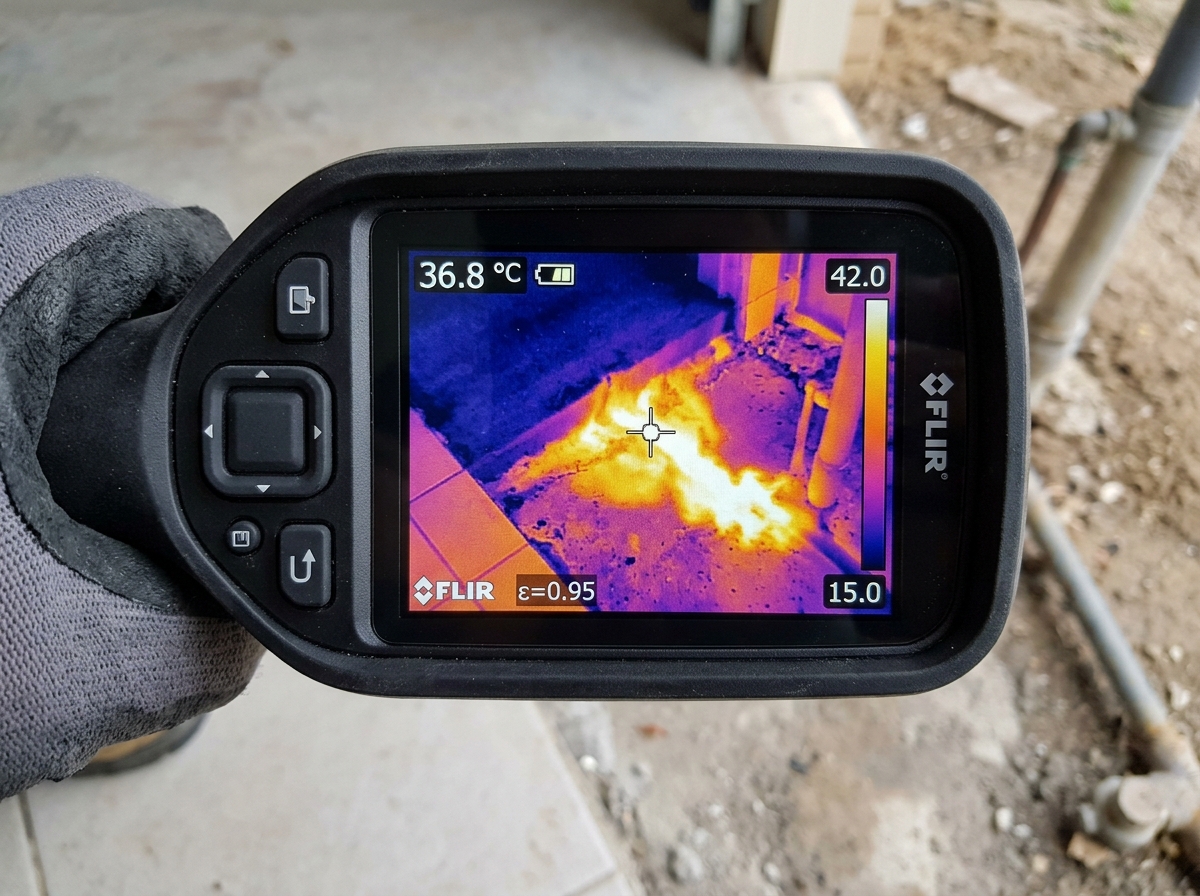
Finding a hot water slab leak without breaking floor surfaces relies on calibrated thermal imaging cameras. When hot water discharges under a concrete foundation, it creates an expanding subterranean heat reservoir. That heat gradually transfers upward through concrete, subflooring, and finish materials via conduction.
Using high-resolution thermographic cameras, a diagnostic specialist scans the flooring across the entire property. The thermal display highlights exact surface temperature differentials, revealing the precise geometric center of the thermal plume. By combining this thermal visualization with electronic acoustic microphones that register the high-frequency hiss of pressurized water, technicians pinpoint the failing pipe location with surgical precision. This approach avoids invasive exploratory damage on historic Santa Fe flooring.
Repairing the Hot Side: Spot Repair vs. Overhead Reroute
Once the exact coordinates of the breach are confirmed, homeowners must evaluate whether a localized spot repair or a line reroute provides the best value:
When a Direct Spot Repair Makes Sense
A direct spot repair involves opening a small concrete pocket directly above the leak point, cutting out the damaged copper section, and soldering or pressing a new commercial-grade copper replacement with protective sleeving. Spot repair is most practical when the leak is situated in an easily accessible utility area, when surrounding copper piping shows no secondary thinning, and when opening the floor does not disturb irreplaceable historic tiles.
Why Rerouting the Hot Water Line Is Often Superior
Because hot water lines fail from thermal fatigue and internal corrosion, fixing one single point under the slab often leaves remaining fatigued copper vulnerable to future breaches nearby. In many Santa Fe homes—especially those with custom adobe plaster, brick floors, or Saltillo pavers—performing an overhead slab leak reroute is far more practical. The leaking under-slab hot line is abandoned in place, and a brand-new, flexible PEX supply line is routed through interior wall framing or insulated ceiling cavities.
If your entire plumbing network is older copper showing multiple corrosion spots, our specialists can also evaluate comprehensive whole-house repiping to permanently solve foundation plumbing vulnerabilities.
Water Heater Replacement Coordination and Maintenance
A hot water slab leak forces your water heater to run non-stop for weeks or months prior to detection. This continuous operation causes heavy sediment accumulation, burner wear, and tank fatigue. As part of our comprehensive service, we evaluate tank condition and coordinate water heater replacement when units have reached the end of their service life, ensuring your repaired plumbing distribution system operates with optimum efficiency.
For additional details regarding general foundation line failures, visit our comprehensive slab leak repair in Santa Fe homepage or learn about diagnosing other hidden pipe ruptures on our water leak detection guide.